Betting is fundamentally about risk: You might win or you might lose. But what if you could always win?
Enter prediction markets, sites that let users bet on pretty much anything. Most of those users lose. But a savvy few have made a fortune using basic math.
Will Gavin Newsom win the 2028 Democratic presidential nomination?
Will the Fed raise interest rates in 2026?
Will Jannik Sinner win Wimbledon?
Here, you can bet “Yes” for 60 cents, implying a 60 percent probability; or you can bet “No” for 40 cents, implying a 40 percent probability. If either bet hits, you win $1.
Prediction sites like Polymarket and Kalshi offer many of the same markets. And usually, they post the same odds.
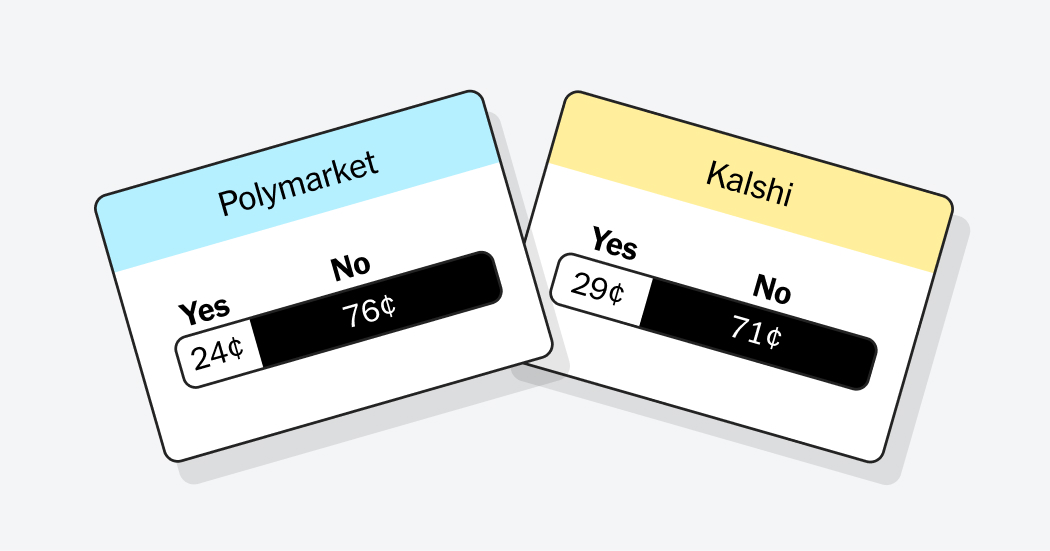
But sometimes the odds diverge — like in these markets about the 2028 Democratic presidential primary race.
In March, Kalshi had Gavin Newsom’s odds of winning at 29 percent, but Polymarket had them at 24 percent. These disparities are good news, if you’re gambling.
Taking both sides of the same bet is usually a wash. But not when there’s a price disparity.
If this sounds like printing money, that’s because it basically is. It’s called “arbitrage,” long a favorite strategy of quantitative traders trying to juice profits from the stock market with minimal risk. You buy something at a cheap price, and simultaneously sell it at a more expensive price. It’s a win-win.
Some bettors are now using the same strategy to rake in thousands of dollars from online prediction sites. Moving quickly, they can take advantage of price gaps between exchanges like Polymarket and Kalshi, or even between the prediction sites and sports-betting sites like DraftKings and FanDuel. The wider the spread, the bigger the potential profit.
Ryan Noel, 25, has built a career arbitrage-betting (or “arbing,” as he calls it) during sports games. He regularly makes more than 1,000 arbitrage bets per week on prediction sites like Polymarket, Kalshi, Novig and ProphetX, in addition to online sportsbooks, he said.
“Software shows me the price of every sort of market at the same time,” said Mr. Noel, who started arbing in late 2023, while working as an actuary, before quitting his job last year. So far, the strategy has netted him more than $1 million, he said. “I don’t care about sports at all. I think watching sports is the most boring thing you can do with your time. I’m a mathematician.”
Math skills are essential — but so are the right tools, said Aidan Gawlowski, a Chicago-based college student who started arbing last year before coding his own software to hunt down prediction-market price discrepancies. Mr. Noel buys software from OddsJam, Pick the Odds and Bookie Beats that tracks price changes across thousands of markets, flagging the possible arbitrage.
“I figured out that there was this opportunity,” said Mr. Gawlowski, 21, who said he started betting when he was 14. “You’re mathematically guaranteed to make money.”
Some moneymaking opportunities last longer than others. The arbitrage with Mr. Newsom? It existed, unexploited, for weeks. During that period, you could’ve bought “Yes” on Polymarket and “No” on Kalshi, for a roughly 3 percent profit. (The probability spread of around five percentage points, minus Kalshi’s transaction fee.)
But there are a couple of reasons that opportunity was an anomaly. For one, the market doesn’t resolve for two years. That’s a long time to tie up money you could invest elsewhere, said Abraham Wyner, a professor of statistics and data science at the Wharton School at Penn. There’s also additional risk that some bets carry more than others: What if the election gets weird, and the sites don’t agree on what defines a Newsom nomination? Then, you might lose both sides of your bet.
That was enough to deter Mr. Noel and Mr. Gawlowski, who spend most of their time arbing on sports. There are loads of sites that let users bet on sports, meaning more chances for price discrepancies. And during games, odds must constantly update to keep up with live developments. That process takes time, which can translate into arbitrage opportunities.
“You can make a significant amount of money on a big N.B.A. day,” Mr. Gawlowski said. During sports games, Mr. Noel’s price-tracking programs catch an arbitrage opportunity every minute or so, he said.
These discrepancies often emerge when casual users, betting based on vibes, move a market just a hair out of alignment. Then arb bettors pounce, and their actions end up evening the odds across the sites again.
Taking advantage of these short-lived opportunities is hard enough for you and me. But the window is closing even for bettors like Mr. Noel and Mr. Gawlowski, as big financial institutions get in on the action with automated bots that can trade faster than any human.
Sophisticated bots compare prices across platforms and identify arbitrage opportunities — just like software Mr. Noel and Mr. Gawlowski use — but they also execute trades, fast. Many prediction platforms let computerized agents place orders without a human. That gives institutions with the wherewithal to deploy bots effectively, and at scale, a huge edge.
Wall Street quant firms like Susquehanna International Group have been recruiting algorithmic traders specifically for prediction markets.
“In the prediction-market space, arbitrage is being dominated by bots,” said Ron Yurko, director of the Carnegie Mellon Sports Analytics Center. “Kalshi and Polymarket encourage it.”
Unlike traditional sportsbooks, prediction markets make money mainly from transaction fees — more transactions, more money. And because bots facilitate speedier trading at higher volumes, the sites have a financial incentive to allow them.
“The big institutions will take out a lot of the arbitrages,” said Nicholas Burgess, who builds and deploys bots for financial institutions, “but they’ll always leave the small ones for retail investors.”
Even so, what’s left is slim pickings. More bots mean the disparities between sites are smaller, and they vanish faster.
“Back in 2022, these arbitrage opportunities would last 30 seconds,” said Alex Llewellyn, 36, a professional sports bettor. “These days I execute bets in two to five seconds. And instead of 8 percent arbs, you generally see 4 to 5 percent.”
Prediction sites are also raising their fees, squeezing the tiny statistical edges that make arbitrage possible. When Polymarket added new fees in late March, Mr. Noel calculated that they would have cost him more than $30,000 a month, if he kept trading at his usual volume.
All this means that free money on prediction markets is probably out of reach now for many ordinary investors.
Prediction sites, awash in Wall Street money and bots, are heading toward the same fate as other major financial markets. One-tenth of the top one percent of accounts on Polymarket rake in more than two-thirds of the profits, a Wall Street Journal analysis found.
“You’re not betting against Joe Schmo anymore,” said Alex Monahan, the founder of OddsJam. “You’re betting against a quant firm with infinitely better technology than you.”